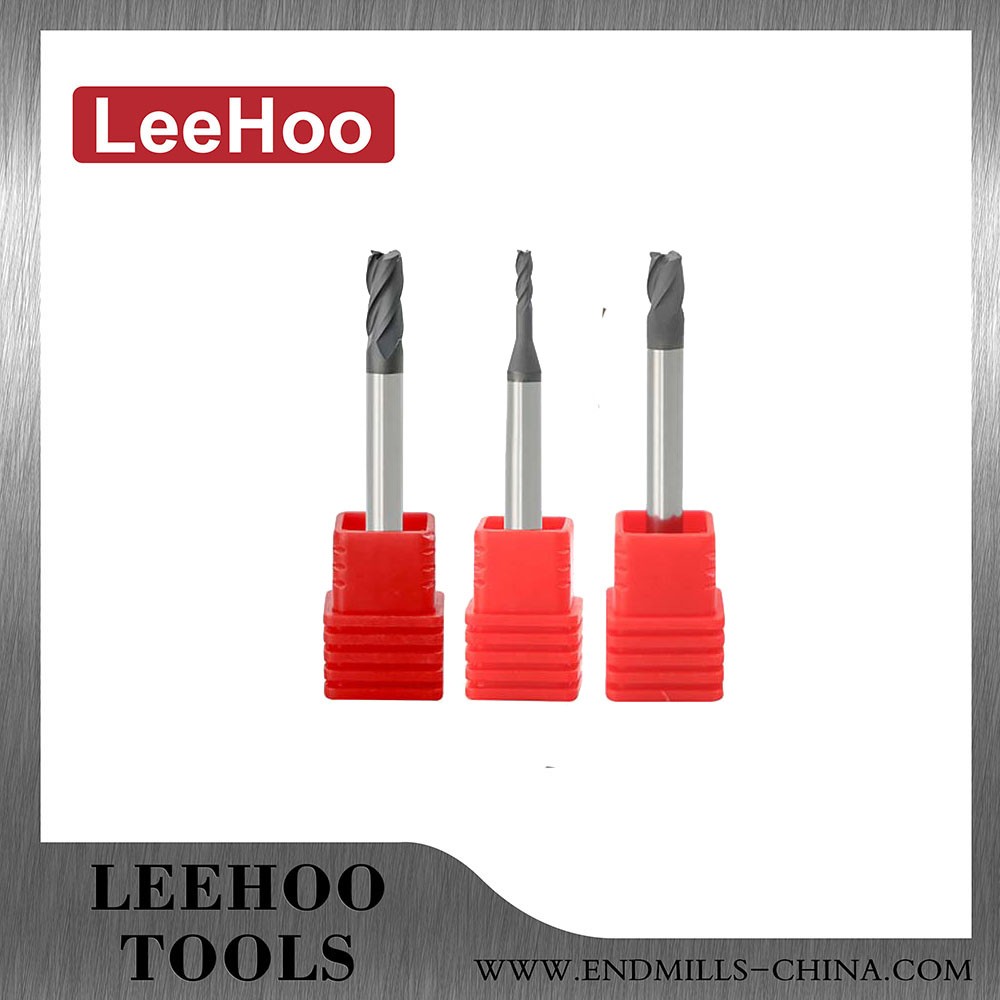
Tungsten Carbide Single Tooth Thread Milling Cutter
Single teeth thread milling cutter
Suitable for processing proofing parts. There are not many threaded holes, many thread specifications, easy to use,single thread processing resistance is small, and deep threaded holes can be processed.
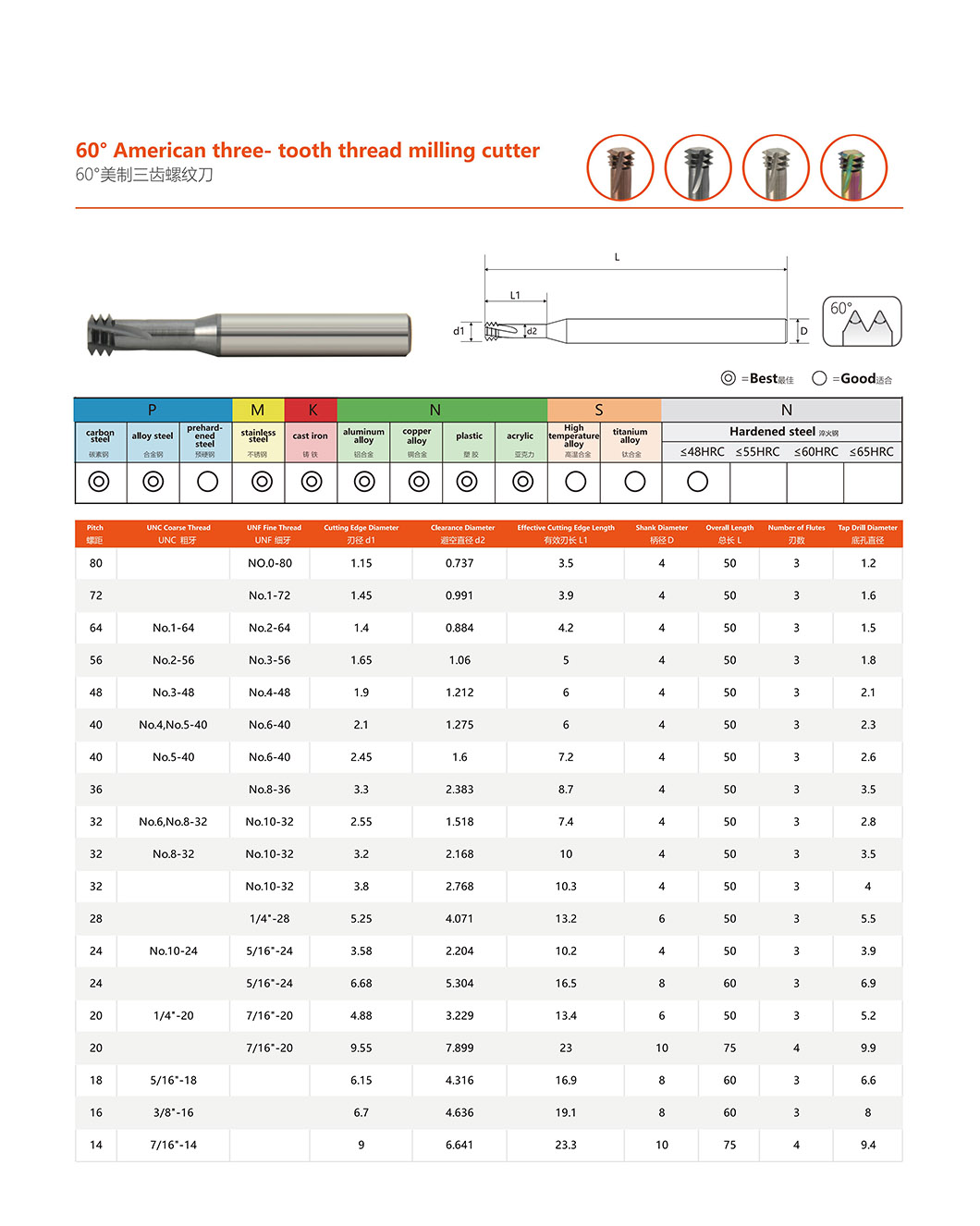
Three teeth
For small hole threads and workpieces with relatively high hardness, the three teech have good rigidity, high strength, and are not easy to break, which directly solves the problem that the tap is easy to break.
Full teeth
Suitable for mass production of the same specifications, depth workpices within 2 times the diamater, high efficiency.
II. Application Scenarios of Thread Milling Cutters
Thread milling cutters are mainly used in CNC milling machines, machining centers, and other equipment. Their applicable workpieces and processing requirements include:
1. Thread Processing of Difficult-to-Machine Materials
For materials with high hardness and toughness such as stainless steel, superalloys, titanium alloys, and composite materials, thread milling cutters exert smaller cutting forces, making them less prone to tool chipping and thread adhesion during processing, which is far superior to traditional taps.
2. Processing of Large-Diameter Threads
For large-diameter internal or external threads (e.g., above M30), tapping with taps results in high tool costs, difficult chip evacuation, and a high risk of tap breakage; thread milling cutters, however, can achieve efficient processing at a lower tool cost.
3. High-Precision Thread Processing
Fields such as aerospace, precision molds, and hydraulic equipment have extremely high requirements for thread dimensional accuracy and surface roughness. Through precise control by the CNC system, thread milling cutters can achieve micron-level processing accuracy with excellent thread consistency.
4. Thread Processing of Thin-Walled and Deformable Workpieces
Thin-walled workpieces are prone to deformation due to excessive cutting forces during processing. Thread milling cutters, with their small cutting forces, can effectively reduce workpiece deformation and ensure thread quality.
5. Processing of Non-Standard Threads or Special Profile Threads
For non-standard pitch and special profile threads, there is no need to customize special tools-only the processing program in the CNC system needs to be adjusted, offering strong versatility.
III. Advantages of Thread Milling Cutters
1. High Processing Precision and Good Surface Quality
The milling process is stable with small cutting forces, which can effectively reduce the surface roughness of threads. Additionally, the dimensional accuracy of threads (such as pitch diameter and thread angle) is easy to control, and precision can be further improved by adjusting tool radius compensation.
2. Strong Tool Versatility and Lower Cost
A single-tooth thread milling cutter can process threads of different diameters in the same pitch series, eliminating the need to equip multiple tools for different diameters like taps. Moreover, cemented carbide thread milling cutters have a much longer service life than taps, reducing tool replacement frequency and costs.
3. High Processing Safety and Reduced Risk of Tool/Workpiece Damage
Traditional taps, once broken during processing, are difficult to remove and may damage the workpiece. Even if a thread milling cutter chips, it will not get stuck in the workpiece. Furthermore, chip evacuation is smooth during milling, and chips can be fully removed with high-pressure cooling.
4. Wide Application Range
They can process both internal and external threads, as well as through-hole and blind-hole threads (blind-hole threads can be milled to the bottom of the hole, while taps are limited by the length of the flutes). They are also compatible with the processing of various materials.
5. High Processing Efficiency (for Multi-Tooth Milling Cutters)
Multi-tooth thread milling cutters have more cutting edges, allowing for significantly higher feed rates. Compared to single-tooth milling cutters and taps, they offer obvious efficiency advantages in mass production.






 Inquire Now